Blackjack Basic Strategy Chart
Basic strategy is the mathematically optimal way to play every possible blackjack hand against every possible dealer upcard. It cuts the house edge to around 0.5%, the lowest of any casino table game. This chart covers 6-deck blackjack with the dealer standing on soft 17 (S17), which is the most common rule set in Vegas and online.
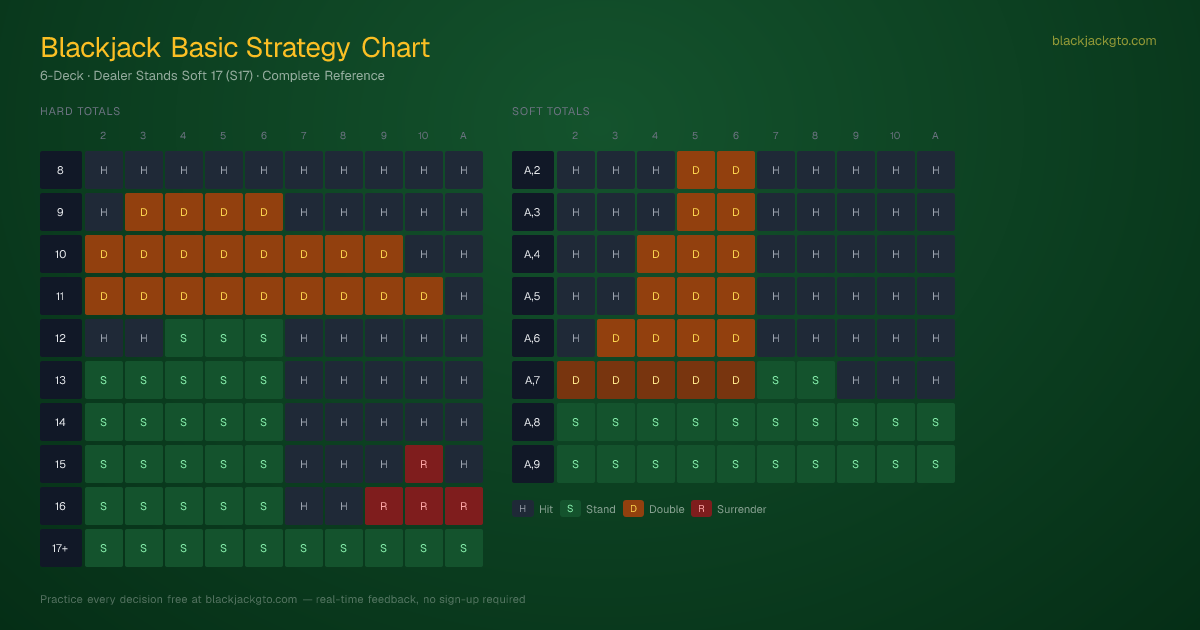
How to read the chart
Find your hand total in the left column. Find the dealer's upcard across the top. The cell where they intersect is the correct play. Always use the chart before relying on intuition. The math does not care how you feel about a hand.
D = Double if allowed, otherwise Hit. Ds = Double if allowed, otherwise Stand. R = Surrender if allowed, otherwise Hit.
Hard totals
A hard hand is any hand without an ace, or with an ace that can only count as 1 (because counting it as 11 would bust you). Hard totals are the most common situation you will face.
| Hand | 2 | 3 | 4 | 5 | 6 | 7 | 8 | 9 | 10 | A |
|---|---|---|---|---|---|---|---|---|---|---|
| 8 | H | H | H | H | H | H | H | H | H | H |
| 9 | H | D | D | D | D | H | H | H | H | H |
| 10 | D | D | D | D | D | D | D | D | H | H |
| 11 | D | D | D | D | D | D | D | D | D | H |
| 12 | H | H | S | S | S | H | H | H | H | H |
| 13 | S | S | S | S | S | H | H | H | H | H |
| 14 | S | S | S | S | S | H | H | H | H | H |
| 15 | S | S | S | S | S | H | H | H | R | H |
| 16 | S | S | S | S | S | H | H | R | R | R |
| 17+ | S | S | S | S | S | S | S | S | S | S |
Hard 8 and below: Always hit. You cannot bust and there is nothing to double for value.
Hard 9: Double against 3–6 only. The dealer is likely to bust with those upcards, so getting more money on the table is correct. Hit everything else.
Hard 10: Double against 2–9. You are likely to make a strong hand; the dealer's 10 or ace is too dangerous to double into.
Hard 11: Double against everything except an ace in a 6-deck S17 game. An ace upcard means the dealer has a strong chance of making 21.
Hard 12: Counter-intuitive: stand against 4, 5, 6 only. Against 2 and 3, the dealer does not bust often enough to justify risking your own bust. Against 7 and above, you must hit.
Hard 13–16: Stand against 2–6 (dealer bust cards), hit against 7 and above. Hard 15 and 16 vs 9, 10, or ace are the most costly hands in the game. Surrender when available.
Hard 17+: Always stand. The risk of busting is too high regardless of dealer upcard.
Soft totals
A soft hand contains an ace counted as 11. You cannot bust by drawing one card to a soft hand, which is why doubling is profitable in more situations than with hard hands. Many players miss out on value by treating soft hands like hard ones.
| Hand | 2 | 3 | 4 | 5 | 6 | 7 | 8 | 9 | 10 | A |
|---|---|---|---|---|---|---|---|---|---|---|
| A,2 | H | H | H | D | D | H | H | H | H | H |
| A,3 | H | H | H | D | D | H | H | H | H | H |
| A,4 | H | H | D | D | D | H | H | H | H | H |
| A,5 | H | H | D | D | D | H | H | H | H | H |
| A,6 | H | D | D | D | D | H | H | H | H | H |
| A,7 | Ds | Ds | Ds | Ds | Ds | S | S | H | H | H |
| A,8 | S | S | S | S | S | S | S | S | S | S |
| A,9 | S | S | S | S | S | S | S | S | S | S |
Soft 13–15 (A,2 / A,3 / A,4): Double only against 5 or 6, the two weakest dealer cards. Hit everything else.
Soft 16–17 (A,5 / A,6): Double against 4, 5, or 6. These hands benefit from doubling because even a bad draw (a 2 or 3) gives you a competitive total.
Soft 18 (A,7): The trickiest soft hand. Double against 2–6 (you already have 18; more money on the table is correct against weak dealer cards). Stand against 7 and 8 (you are likely ahead). Hit against 9, 10, and ace. Standing on 18 against a dealer 9 is a common mistake.
Soft 19–20 (A,8 / A,9): Always stand. You have a strong hand. There is no upcard that justifies risking it.
Pairs
When you are dealt two cards of the same rank, you have the option to split them into two separate hands, each starting with one of those cards. Splitting is only profitable in specific situations. This table assumes double after split (DAS) is allowed, which is standard in most games.
| Hand | 2 | 3 | 4 | 5 | 6 | 7 | 8 | 9 | 10 | A |
|---|---|---|---|---|---|---|---|---|---|---|
| 2,2 | P | P | P | P | P | P | H | H | H | H |
| 3,3 | P | P | P | P | P | P | H | H | H | H |
| 4,4 | H | H | H | P | P | H | H | H | H | H |
| 5,5 | D | D | D | D | D | D | D | D | H | H |
| 6,6 | P | P | P | P | P | H | H | H | H | H |
| 7,7 | P | P | P | P | P | P | H | H | H | H |
| 8,8 | P | P | P | P | P | P | P | P | P | P |
| 9,9 | P | P | P | P | P | S | P | P | S | S |
| 10,10 | S | S | S | S | S | S | S | S | S | S |
| A,A | P | P | P | P | P | P | P | P | P | P |
Always split aces and 8s. Splitting aces turns a mediocre soft 12 into two chances at 21. Splitting 8s turns a terrible hard 16 into two hands starting at 8, which is a strong starting point.
Never split 5s or 10s. A pair of 5s is hard 10, one of the best doubling hands. Splitting destroys that. A pair of 10s is 20, the second best hand in the game. Never break it up.
9s: Split against 2–9, except stand against 7 (your 18 beats the dealer's likely 17), 10, and ace.
2s, 3s, 7s: Split against 2–7 (dealer bust zone and matching range). Hit against 8 and above. The dealer is too strong.
6s: Split against 2–6 only. Against 7 and above the dealer is too likely to make a strong hand.
4s: Only split against 5 or 6 when DAS is allowed. Otherwise hit. Splitting 4s into two weak starting hands is rarely correct.
Surrender
Late surrender lets you fold your hand and recover half your bet after the dealer checks for blackjack. Most players never surrender because it feels like giving up, but against the right dealer upcards, surrendering is mathematically better than playing out the hand.
| Your hand | Surrender against | Why |
|---|---|---|
| Hard 16 | 9, 10, Ace | Win rate is below 25%, losing more than 50 cents per dollar played |
| Hard 15 | 10 | Only marginally losing vs 9 and A, but clearly losing vs 10 |
Note: 8,8 vs 10 looks like a surrender candidate but splitting is still correct because each 8 has a better expected value than folding. Always split 8s, even against a 10.
The 5 most expensive mistakes
These are the deviations from basic strategy that cost players the most money. Each one feels intuitively correct, which is exactly why they are so expensive.
- 1.Standing on soft 18 (A,7) vs dealer 9, 10, or ace18 feels safe. It is not. The dealer makes 19 or better often enough against these upcards that hitting soft 18 is significantly better than standing.
- 2.Not doubling 11 against a dealer 10Players fear the dealer's 10. But your 11 is statistically the best double in the game. You will make 20 or 21 on about 30% of draws, and any total beats a dealer bust.
- 3.Splitting 10sA 20 wins roughly 93% of the time. Splitting it into two separate hands starting at 10 is giving up a near-certain win to gamble twice.
- 4.Not splitting 8s against a dealer 10Hard 16 is the worst hand in blackjack. You lose more often than not regardless of how you play it. Splitting gives you two hands starting at 8, each with positive expected value.
- 5.Taking insuranceInsurance pays 2:1 if the dealer has blackjack, but the dealer only has a 10 in the hole about 30.8% of the time in a 6-deck shoe. You need 33.3% to break even. Insurance is a losing side bet unless the true count is +3 or higher.
Why basic strategy works
Basic strategy was developed in the 1950s by Roger Baldwin and colleagues using mechanical calculators. They computed the expected return of every possible play for every possible hand and dealer upcard. Modern computers have verified and extended this work. The strategy presented here is correct to multiple decimal places.
Without basic strategy, the average blackjack player gives up around 2–4% to the house through suboptimal decisions. With perfect basic strategy, the house edge drops to approximately 0.5%. That is the starting point. Card counting then pushes it further.
The chart above assumes: 6 decks, dealer stands on soft 17, double after split allowed, late surrender allowed. Rule variations change the edge slightly. Every rule in the trainer matches this chart exactly.
The Blackjack GTO trainer checks every decision you make against this exact strategy chart and explains your mistakes in plain English. No money, no sign-up. Just repetition until the decisions become automatic.
Open the trainer →